Editor's note: Tony Grossi is a Cleveland Browns and NFL analyst for TheLandOnDemand.com and 850 ESPN Cleveland. He has covered the Browns since 1984.
(Caution: The following story may cause severe headaches and indigestion problems to Browns fans.)
In seven years on the job, Andrew Berry has established himself among the most aggressive GM “kickers.”
As in, kicking the can of salary cap charges down the road.
He’s right up there with Philadelphia’s Howie Roseman and New Orleans’ Mickey Loomis in creating cap room with elaborate contract restructurings and bonus conversions, topped off by “dummy” or void years at the end of contracts to further dilute cap charges in the present and roll them into the future.
“One of the things we feel like is a competitive advantage for us has been our contract management philosophy,” Berry said in March of 2024. “We’re firm believers that in that space the best front offices and the best teams are proactive as opposed to reactionary in market dynamics.”
There comes a time, however, to pay the charges once they’re used up. And that is what the Browns are doing this year – and for the next several years.
Which is one reason why Berry and owner Jimmy Haslam have been conditioning fans to expect one of the league’s youngest teams in 2026. Eventually, the “dead cap charges” of players no longer with the team lower the total cap space and force an influx of younger players with smaller salaries and cap numbers.
Thus, it puts an even higher premium on the draft. Which is why a draft-savvy team like the Eagles have effectively pulled off this exercise while the Saints and Browns have not had as much success.
Paying the piper
Over the years, Berry did financial gymnastics with the contracts of Joel Bitonio, Jack Conklin, Wyatt Teller, David Njoku, Ethan Pocic, and others. And this week, the dead cap charges of those departed players started piling up.
Keep in mind, dead cap charges are not cash money. They are deductions from the team’s salary cap.
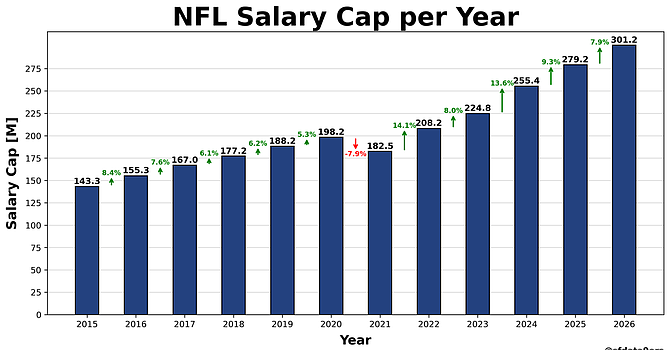
This year’s NFL salary cap is $301.2 million per team Some teams are able to roll in excess salary cap room saved from the previous year. The Browns rolled $20.1 million into their 2026 cap. So not every team’s starting cap is the same. But whatever the team’s salary cap figure, the dead cap charges reduce it.
When a player’s dummy years automatically void, the dead cap charges are assessed. On Wednesday, Bitonio’s four dummy years voided when he was technically released. His dead cap charge: $23.5 million.
On Thursday, the dummy years on contracts for Jack Conklin, David Njoku and Wyatt Teller were voided. The charges?
Conklin: $12.4 million.
Njoku: $24.33 million
Teller: $21.304 million.
Teams are allowed to designate a maximum of two players as post-June 1 releases, which allows their dead cap charges to be spread over two years. Njoku and Teller were the designees this year. So after June 1, Njoku’s charges come to $9.534 million in 2026 and $14.796 million in 2027. Teller’s charges are $8.293 million in 2026 and $13.011 million in 2027.
(All figures are culled from Spotrac.com and Overthecap.com.)
According to Overthecap.com, the Browns have $77.141 million in total dead cap charges in 2026. That ranks third-most to the Saints ($113.971 million) and Dolphins ($89.603 million).
Other departed players contributing to the Browns’ dead cap charges include Dalvin Tomlinson ($12.109 million), Juan Thornhill ($5.668 million), and Dustin Hopkins ($2.776 million).
It’s not ending soon
This is a big haul of dead cap charges in 2026, but it’s certainly not the end of it.
In 2027 and 2028, the Browns will be faced with the fallout of the end of Deshaun Watson’s contract, which has been tapped for salary-to-bonus conversions in each of his five years, kicking cap charges to the end.
Next year, a mechanism already in place will trigger the void of four dummy years Berry has attached to Watson’s contract and result in $86.2 million in dead cap charges.
(One way to look at it is this: Over five seasons, Berry created $86.2 million in cap room through his five conversions of Watson’s contract. That was intended to create room to sign other players. It resulted so far, however, in an overall team record of 26-43, including one playoff loss.)
When Watson is designated a post-June 1 release a year from now, his cap charges will be $34.663 million in 2027 and $50.446 million in 2028. So because of the conversions, Watson's five-year, fully guaranteed, $230 million deal actually will have haunted the Browns for seven years.
It’s important to note that the salary cap continues to increase. That’s one reason for the philosophy of kicking the charges down the road. For instance, Watson’s future cap charges will consume less of a percentage of the total cap in 2027 and 2028.
One other consequence of using dummy years to create salary cap space is the forfeiture of possible compensatory draft picks.
Ordinarily, when a player’s contract runs out and he leaves for another team in free agency, the team could be eligible for a compensatory draft pick in the following season’s draft.
The complex formula depends on net losses in free agency v. net gains in a given year. But when a player’s contract voids because of dummy years and the player is released after the start of the league year, it is not eligible for compensatory consideration.
So if Njoku, Conklin, Teller, Bitionio and, even Watson next season, sign with new teams, the Browns won’t realize any compensatory picks from their departures.