Editor's note: Tony Grossi is a Cleveland Browns and NFL analyst for TheLandOnDemand.com and 850 ESPN Cleveland. He has covered the Browns since 1984.
INDIANAPOLIS, IN
One of the biggest decisions the Browns will make in the draft concerns Ohio State safety Caleb Downs.
Do they resist the urge to fill urgent needs on offense with the No. 6 overall pick and take what some believe is the best defensive player in the draft?
Or do they parlay widespread interest in Downs as a chip to trade down, collect extra draft assets, and address the offense at tackle or wide receiver?
Downs’ on-field credentials are impeccable – two-time unanimous All-American, Big Ten defensive player of the year, Jim Thorpe Award winner, key player on the 2024 CFP national championship Buckeye team.
So, what’s not to like?
Aside from the Browns’ strength on defense, there is an NFL stigma about taking a safety in the top 10 of the draft. Jamal Adams (sixth overall in 2017) was the last safety selected that high.
Only five safeties since 1970 have gone off the board in the top five. They are Kenny Easley of Seattle (1981), Rickey Dixon of Cincinnati (1988), Eric Turner of the Browns (1991), Sean Taylor of Washington (2004), and Eric Berry of Kansas City (2010).
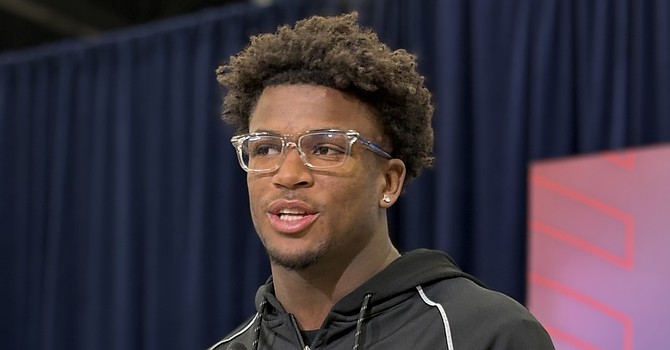
At his Combine podium appearance on Thursday, Downs eloquently defended the value of taking a safety high.
“At the end of the day it’s ‘who’s the best defender?’” Downs said. “I mean, it’s not like really positional value. It’s who affects the game. If you affect the game in a lot of ways, that’s what’s most important.
“So, that’s really all I can worry about. Honestly, I can’t worry about what anybody else says or what the coaches have done. At the end of the day, my film is what it is, and they’re gonna make a decision based off of it.”
Downs cited his versatility to play all over the field – in the box, covering a slot receiver, or as a deep safety – and his instincts as the traits that put him ahead of all defenders in this draft.
“My confidence level is always at the highest when I’m on the field, and the belief in myself really never goes down,” he said. “No matter the circumstance. So I feel like my mind really puts me above a lot of people in terms of how I process the game and play with instincts, and I feel like that’s what makes me special.
He identified the Cowboys as one team he’s met with at the Combine but didn’t want to mention any others.
The message he’s trying to get across to teams in interviews:
“You’re getting a really talented player. You’re getting a smart player that can come and make an impact on the field and in the facility, to make a culture change. That’s what you’re getting.”
Downs sounded like a student of the position when he was asked to name his top five NFL safeties.
“I like watching a lot of safeties so I’m gonna go … Brian Branch [of Detroit]. I like his game a lot. Kyle [Hamilton, of Baltimore]. I love how Budda [Baker, of Arizona] plays, the intensity he plays with. Kevin Byard [of Chicago], his film this year was crazy. I'm gonna do Derwin [James, of the Chargers.]”
A few minutes later, he added Nick Emmanwori [of Seattle] to his list of favorites.
“[Safeties are] changing the game,” Downs said. “Nick changed the game this year with his size and how he played and the physicality he played with, and then also being able to play the coverage that he played. He had a great year, and I told him that whenever I saw him.”
The Browns reinvested in safety Grant Delpit with a three-year contract extension in December of 2023. His contract effectively runs out after the 2026 season.
Monken the play-caller … or not?
Todd Monken eliminated the mystery of who’s calling the offensive plays on game days when he flatly stated that he would at his introductory press conference.
He indicated, however, it could change over time – as it did during his only other stint as a head coach at Southern Mississippi from 2013-15.
At the Combine, a question came out of the blue about Chip Lindsey, who is moving from Michigan to become offensive coordinator at Missouri. Lindsey was Monken’s offensive coordinator at Southern Miss in 2014-15.
“We were running Air Raid,” Monken said. “I mean it's four wide, you're throwing it around, minimal run schemes and he fit what we were looking for at that time. We would've never done what we did at Southern Miss without him because I turned the play-calling over to him and it allowed me to be a hell of a lot better head coach.”
So, the natural question is whether Monken would follow that same route as a CEO head coach with the Browns.
This week, two renowned offensive-oriented head coaches – Sean Payton of Denver and Dave Canales of Carolina – announced they were handing over play-calling duties to their top offensive assistants.
“I don't see it at this point, but you never say never,” Monken said. “I mean, you got to get things going in the direction you want, work with somebody long enough to where you feel comfortable handing that over. We're not at that point yet.”
Monken brought Travis Switzer from the Ravens and named him his offensive coordinator. Switzer was Ravens run game coordinator the three years Monken was Baltimore’s OC.
At arm’s length
The Browns will be one of the teams very interested when offensive linemen are weighed and measured on Sunday.
One of the big questions about Miami offensive tackle Francis Mauigoa concerns his arm length. Some teams feel better about moving tackles with shorter arms inside at the guard position. The measurement threshold is 33 inches.
The same question came up with Will Campbell last year. His arms were measured at 32 5/8. The Patriots lined up Campbell at left tackle, anyway, and he was a big factor in New England’s stunning turnaround from 4-13 to AFC Champions.
Campbell had a rough time in the post-season, however, and that raised questions again about whether the short arm length caught up with him against the better defenses the Patriots faced in the playoffs.
Patrots GM Eliot Wolf disputed the short arm theory, and attributed Campbell’s drop-off to an MCL sprain in his right knee in late November.
“When Will came back from that injury, I personally didn't see the same level of lower body strength that you saw before the injury, and I think you know, the film would attest to that,” Wolf said. “He probably had three of his four worst games in the playoffs. But before that, I thought Will played really well all year.
“I know everyone talks about the arm length, but he has a set of skills that enable him to play with that arm length. He's really quick out of his stance. He's technically sound. He's adding more and more different pass sets to his tool bag that he can use to combat different rushes. And again, he's 22 years old, and we expect some improvement out of him as well.”
Still, Mauigoa’s arm measurement might drop him closer to the Browns at No. 6 if it comes below the 33 in. threshold.