
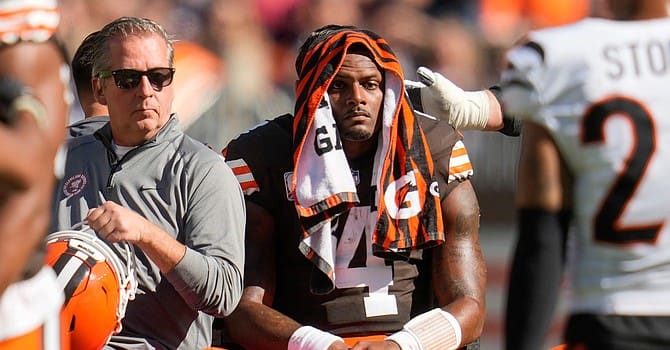
Deshaun Watson’s contract was simple and straightforward when he joined the Browns via a controversial trade with the Houston Texans in 2022 – five years at $46 million guaranteed each year, $230 million in total.
It remains the biggest fully guaranteed contract in NFL history.
Over time, the deal has aged in different ways and become infinitely more complicated.
Buffalo’s Josh Allen has surpassed Watson in guaranteed money. Allen’s newest deal for $330 million contains $250 million in guarantees. Also, Watson’s $46 million annual average salary has plummeted from first to 13th among NFL quarterbacks. At $46.5 million per year, even Packers pass rusher Micah Parsons has edged ahead of Watson in yearly average salary.
If Watson’s contract had been left alone, he would be carrying a salary cap charge of $46 million in 2026 – the last year of the deal — which is a moderate 15.2 percent of the estimated $301.2 million total salary cap for teams this year.
But because of repeated salary-to-bonus conversions done by the Browns in each of the first four years of the deal, Watson currently carries a cap charge of $80.7 million in 2026 – 26.8 percent of the total team cap.
With the help of noted salary-cap expert Jason Fitzgerald, founder of Overthecap.com, I try to answer some frequently asked questions about Watson and the ramifications of his contract.
Watson has played in only 19 of a possible 68 games for the Browns because of his NFL suspension in 2022 and multiple injuries since. At this point, why wouldn’t the Browns just cut their losses, release him and move on?
There are three reasons:
1. If they released him, they would suffer dead cap charges of approximately $131.16 million spread over the 2026 and 2027 seasons. Essentially, they would eat $80.7 million in cap space in 2026 and $50.4 million in 2027.
2. By keeping Watson and doing one last salary-to-bonus conversion, the Browns can reduce Watson’s 2026 cap number to about $46 million and actually create about $34 million in cap room this year. That is accomplished by reducing Watson’s base salary to the NFL minimum of $1.3 million and paying the remaining $44.7 million as a cash bonus. For accounting purposes, the bonus allotment is spread over three “dummy years” written into the contract previously.
3. Watson’s recovery from two Achilles tendon surgeries last year has gone well and the Browns expect him to compete for a viable roster spot, either as the starter or as the veteran backup quarterback. Without him, they would have to suffer the cap charges in addition to adding another veteran QB.
How will Watson’s contract affect the Browns after it expires at the end of 2026?
According to Fitzgerald, if the Browns, in fact, do another salary-to-bonus conversion, there will be $86.2 million in cap charges to account for after 2026. That number will be reduced some by a salary cap credit due to the fact the Browns took out an insurance policy last year in the event Watson didn’t play in 2025, which he didn’t. Fitzgerald does not know the amount of the credit; it is not expected to be substantial.
Last year, the Browns negotiated a “dummy guarantee” of $200 million if Watson is on the roster early in the 2027 league year. Per Fitzgerald, that was done for the sole purpose of allowing the team to designate Watson a post-June 1 release in 2027 and split the cap charges as $51.54 million in 2027 and $34.66 million in 2028.
Why did the Browns restructure Watson’s contract every year and add all these future cap charges?
They did it in 2022 because Watson and his agent knew an NFL suspension was coming and they wanted to preserve as much of his $46 million as possible. The eventual 11-game suspension that year essentially cost Watson $670,000 in lost wages instead of $29.7 million had his base salary remained at $46 million.
In subsequent years, the Browns did the salary-to-bonus conversions to create cap room for other roster additions. “Kicking the can forward” added cap charges to the back of Watson’s contract.
Could the Browns have done anything differently to alleviate some of the dead cap charges?
“I think it’s clear the team could have handled the contract better,” Fitzgerald wrote in an email.
First of all, the contract the Browns negotiated with Watson after satisfying Houston’s trade price (three No. 1 draft picks, and three mid-round picks) represented a $70 million one-year extension over a four-year, $160 million contract given him by the Texans in September of 2020.
Fitzgerald believes the Browns should have bitten the bullet and not done the salary-to-bonus conversion in at least one year to lessen the future cap charges.
“Instead they followed the same path and continued to kick the can with Watson, added too much salary elsewhere, and got nothing out of it,” Fitzgerald wrote.