Editor's note: Tony Grossi is a Cleveland Browns and NFL analyst for TheLandOnDemand.com and 850 ESPN Cleveland. He has covered the Browns since 1984.
(The Pro Football Hall of Fame Class of 2026 unveiled on Thursday night was Larry Fitzgerald, Luke Kuechly, Adam Vinatieri, Roger Craig and Drew Brees.)
This year’s Pro Football Hall of Fame selection meeting, conducted remotely for the sixth consecutive year via Zoom, was held in mid-January. It started at 10 a.m. and adjourned at 6:15 p.m.
What on Earth could take that long?
Eight-plus hours is longer than a Browns head coach interview, homework assignments included.
Every year I offer a glimpse into the meeting, but it can’t be too detailed because of strict confidentiality rules hammered into the heads of the 50 selectors by Jim Porter, president of the Hall of Fame.
We voters are constantly asked by the HOF to engage in thoughtful discussion on each candidate. The reason the HOF binds everyone to confidentiality is to encourage discussion that could be both positive and negative without fear of outside retribution.
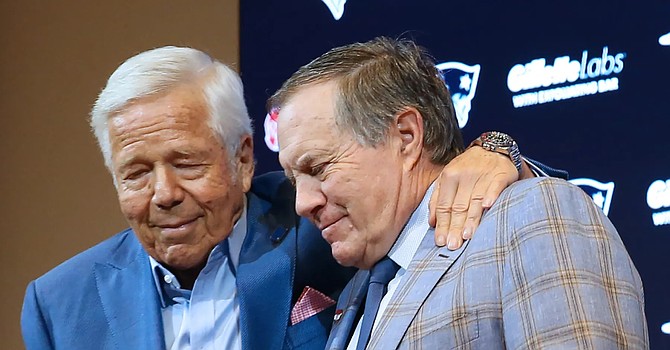
Unfortunately, that confidentiality was breached this year when it was leaked to ESPN reporters Don Van Natta Jr. and Seth Wickersham a week ago that Bill Belichick fell short of the necessary 80 percent voter approval to gain election in his first year of eligibility. A few days later, ESPN reported that Robert Kraft – Belichick’s boss with the New England Patriots for 24 years -- also missed election.
We voters were spared of blame for the leaks because none of us was informed of the final results – even after eight-plus hours of doing all the work. This is a relatively new and controversial nuance of the voting process, which is constantly reviewed by the Hall.
A firestorm of controversy over other facets of the Hall’s voting process erupted after the revelations of Belichick’s and Kraft’s omission from the 2026 class. These centered mostly on the rules governing the election of the special category finalists – three players from the Seniors category (whose modern-era eligibility of 20 years had expired), one coach and one contributor.
Crux of the controversy
In the past, there would be one senior and one coach and/or one contributor, and each was voted on separately with a yes or no vote, with 80 percent yes votes (or 40 of 50) needed for election.
Two years ago, the Hall added two more seniors as finalists to accommodate a massive backlog of forgotten yet deserving player candidates. But the Hall also changed the voting procedure. Instead of voting on each special category finalist separately, selectors were instructed to vote on three of the five. That tweak diluted the votes and made it much more difficult for anybody to receive 80 percent yes votes. If nobody received 80 percent, the highest vote-getter got in.
In the first year of this change, only one of the five finalists was elected – Packers receiver Sterling Sharpe. The coach, Mike Holmgren, and contributor, Ralph Hay, were shut out – innocent victims of the new procedure.
Belichick and Kraft fell victim similarly. There has been a prevailing sentiment among many selectors to vote for the senior finalists who were facing perhaps their final opportunity to gain HOF immortality at the expense of the coach and contributor, who can more easily be brought back in future years.
This unintended consequence of the new procedure exposed a major flaw and subjected voters to undeserved ridicule. It probably will be changed, but the damage was done.
Now, on to the meeting …
On the clock
Each of the 20 finalists this year – five in the special categories and 15 modern-era eligibles (up to 20 years after retirement) – were presented by a pre-determined selector. And then everyone else is invited to contribute to the discussion.
I put a clock on the discussions because the time spent debating a candidate usually, but not always, reflects the diversity of opinion about that candidate.
So here are my clockings of discussion times with each finalist:
1. Bill Belichick (coach): 45 minutes, 38 seconds.
2. Eli Manning: 35:55.
3. Roger Craig (senior): 32:45.
4. Ken Anderson (senior): 21:26.
5. Larry Fitzgerald: 20:49.
6. Darren Woodson: 19:35.
7. Torry Holt: 19:09.
8. Adam Vinatieri: 18:39.
9. Robert Kraft: 17:08.
10. Willie Anderson: 17:06.
11. Drew Brees: 16:55.
12. L.C. Greenwood (senior): 14:22.
13. Luke Kuechly: 13:42.
14. Frank Gore: 13:05.
15. Jason Witten: 10:44.
16: Reggie Wayne: 10:02
17. Kevin Williams: 9:55.
18. Jahri Evans: 9:25.
19. Marshal Yanda: 9:05.
20. Terrell Suggs: 6:37.
The Belichick discussion, obviously, ruled the meeting in time, passion, and controversy.
The crux of the discussion centered on Spygate, the 2007 scandal in which Belichick was “tried” and “convicted” in the court of the NFL for illegally taping defensive signals to gain an edge in future games. The NFL ultimately fined Belichick $500,000 and the Patriots franchise $250,000 and the loss of a first-round draft pick.
After the opening presentation of Belichick, 23 of the 50 voters spoke during the 45+ minute “discussion.” Multiple selectors expressed the opinion that it would be an embarrassment to the selector committee if Belichick, winner of six Super Bowls as Patriots head coach and two others as an assistant coach, were not selected on his first year of eligibility. I agreed.
When the meeting ultimately adjourned, I thought the length of the discussion was the story of the day. Never did I imagine Belichick would fail to receive the required 40 votes for election. Same with Kraft.
My votes in the special category finalists went to Belichick, Kraft and Anderson.
Eli's calling
Among the modern-era finalists, Manning’s discussion was the most passionate for the second year in a row.
In his first year of eligibility in 2025, Manning’s discussion consumed 52 minutes, 9 seconds. This year, it lasted 35:55. The result was the same – Manning did not make the first cut from 15 to 10 a second year in a row.
Ultimately, Manning’s two Super Bowl victories over the Patriots, and two SB MVP awards, failed to overcome arguments about his 117-117 career won-loss record, his 0-4 post-season record other than his two Super Bowl years, and the fact he led the NFL in interceptions three times.
Voting on the modern-era candidates began seven hours into the meeting. The first vote cut the field of 15 to 10. Then we were asked to cut the 10 to seven.
The final vote reflected another recent change in the process.
We used to cut it to five, and then voted on each of the five separately – yes or no.
Now, when we got to seven, we were asked to vote for five. Only those who received 80 percent – 40 of 50 – got in.
My final five were Wilie Anderson, Brees, Fitzgerald, Suggs and Vinatieri.