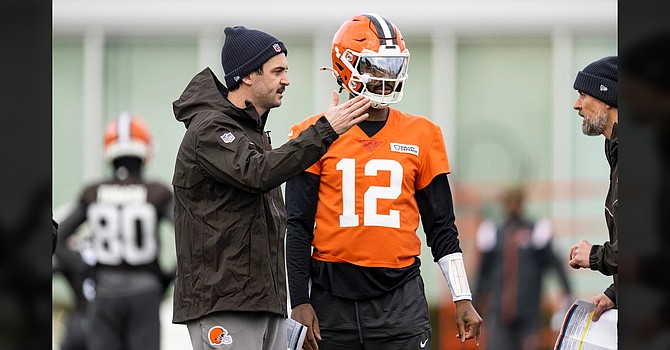
Editor's note: Tony Grossi is a Cleveland Browns and NFL analyst for TheLandOnDemand.com and 850 ESPN Cleveland. He has covered the Browns since 1984.
Shedeur Sanders has improved in some areas in four games as Browns starting quarterback. But the quarterback shakes his head at one aspect of his game.
“I just got to get more completions. You know, I gotta get more completions,” Sanders said as he prepared for his fifth NFL start Sunday against the Buffalo Bills.
“And even when we’re down or anything, I can’t press, you know. I just gotta remain having those mental notes to myself. Just work within the game and just keep driving the ball, get first downs.”
It’s a spot-on assessment of his game so far.
Sanders has indeed added the explosive play element to the Browns’ pass offense. In four games, he’s made eight completions of 29 yards or more, including four to Isaiah Bond. (These don’t count three catch-and-runs of 30 yards or more to Dylan Sampson and Quinshon Judkins, which were the result of long runs by the backs after short passes.)
But Sanders’ overall completion percentage of 52.2 is by far the lowest of any NFL quarterback with four or more starts. If you take away his 4-of-16 performance in the second half in relief of Dillon Gabriel against Baltimore, Sanders’ completion mark in his four starts is 55.7. The NFL average is 64.3. Sanders led all major college quarterbacks his last season at Colorado with a 74.0 completion percentage.
Most rookie quarterbacks do suffer a drop-off in completion percentage in their first year in the NFL. But Sanders’ is dramatic.
Cam Ward was a 66.0 percent QB in his college career. He’s at 59.3 in his first NFL season with Tennessee.
Jaxson Dart was 65.2 in his college career. He’s at 62.5 with the Giants.
Tyler Shough actually has improved from 63.0 in college to 66.7 with the Saints.
Gabriel was 65.2 in college; 59.5 with the Browns.
“I think I got to complete the ball more, honestly. I mean, there’s no excuse when it comes to that,” Sanders said.
What’s a little disconcerting, too, is that Sanders has the longest average amount of time (3.33 seconds) to deliver the ball among starting quarterbacks, according to NextGenStats. Which means he’s holding onto the ball longer than anyone.
The splash plays are nice, but Sanders knows he can’t be a one-trick pony.
“We can’t just be a deep ball thrower,” he said. “We gotta be able to complete stuff when the deep ball’s not there. So that’s what I’m trying to get better with in my game.”
I asked him why he’s not more accurate on the shorter throws.
“That stuff requires more [being on the] same page,” he said. “Deep balls are more like … you can anticipate a little more, because you know the area around where they’re gonna be, the margin of error you have for them in those reps. It’s easier, but you just gotta always be on the same page.
“Like, the Tennessee game. The dialogue me and Jerry [Jeudy] have, the dialogue me and all the receivers have when it’s a different type of game. ‘Hey, get your eyes around a little quicker, we’re gonna have to get to these spots a little faster,’ because I may be there, but then it may have not developed fully yet. But then it’s just playing on the same time, like thinking the same thing. So, all that stuff comes with understanding each other, and that’s just a tough thing. It’s just a tough thing we dealt with.”
More game reps should improve his accuracy overall. Completion percentage can vary based on opponent, venue and weather conditions, of course.
Sanders’ NFL debut was in the Las Vegas dome stadium and he connected on 55 percent of his throws. His next game in Cleveland against the 49ers was his best, 64 percent. He passed for 364 yards in the Tennessee game in Cleveland, but his percentage fell to 54.8. The game last Sunday in minus-1 wind chill in Chicago was his lowest yet, 51.4 percent.
“Winning’s the final goal,” Sanders said. “You just gotta focus on that. And the more plays you stack, the more completions you rack up, the better chance you have at winning. So, have I been playing winning football lately? Nah, I don’t think so. But it’s something I have self-evaluated and applied to my game.”
Brownie bits
Right guard Wyatt Teller, who was pulled for Teven Jenkins in the Tennessee game and then suffered a calf injury, returned to practice, while Jenkins was out with a shoulder injury. Teller rotated with Jenkins in the game he celebrated his 100th career start. “It’s tough going out like that especially on a day you had 100 starts,” he said. “But it’s business. I can’t get too emotional about the business side.” Teller previously said he wanted to finish his career as a Brown. But the recent benching puts that hope in doubt. His contract is up after this season and there is no indication the Browns will bring him back. “I’m not going to be a sad boy about it. It is what it is,” he said …
Besides Jenkins, players who did not practice on Wednesday included: guard Joel Bitonio (knee), offensive tackle Jack Conklin (concussion), defensive end Myles Garrett (not injury related), defensive tackle Michael Hall (illness), tight end David Njoku (knee), running back Dylan Sampson (hand), and cornerback Denzel Ward (calf). Coach Kevin Stefanski said he wouldn’t rule anyone out for the Buffalo game just yet …
The Browns signed interior linemen Wesley French to the practice squad. He has appeared in 17 NFL games since 2022. The Browns needed another backup center to Luke Wypler because Garrett Dellinger, who served that role in Chicago and had to fill in for Jenkins at right guard, was claimed by the Titans.