
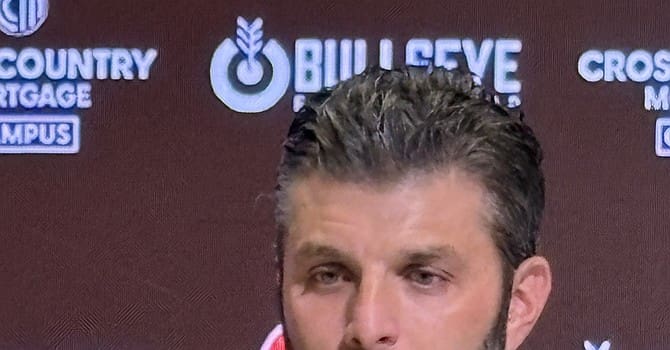
At age 60, Todd Monken will be the third-oldest Browns head coach when he makes his debut in September.
Perhaps Monken wanted to balance that age difference with his 20-something players by surrounding himself with young coordinators.
The over-riding takeaway from the introduction of Monken’s coordinators is how young, energetic and excited they are. Each is getting his first crack at NFL coordinator.
Offensive coordinator Travis Switzer was the starting center at Akron just 12 years ago. If he was good enough to make an NFL roster, he’d still be playing. He’s 33.
Special teams coordinator Byron Storer had his playing career as a fullback prematurely ended in 2009 by two knee injuries. He’s 41, but looks closer to 21.
Defensive coordinator Mike Rutenberg broke into the NFL as a personnel intern at the age of 22. At 44, his energy flooded the Browns media room. He burst to the podium like he was breaking a huddle on fourth-and-1.
Here are more takeaways from Monken’s top lieutenants.
Travis Switzer, offensive coordinator
1. I don’t want to read too much into this, but it was interesting to hear Switzer’s first remarks about the present Browns quarterback room.
“Monk said this in his opening press conference,” Switzer said. “You don’t take a job if you’re not excited about the quarterbacks that are in the building, and it’s more than one. We’re excited about Dillon [Gabriel], we’re excited about Deshaun [Watson]. You know, anytime you have a guy who has had the success that he’s had, he’s got to be part of the equation when it comes to competing for that job. And then Shedeur [Sanders], what he was able to show last year, you know. He’s still young. He has a lot of growth that he can still achieve, especially [from] year one to year two. He only started, what, six, seven games last year? So yeah, I think there’s a lot to be excited about in that room.”
The fact Switzer mentioned Gabriel first made me think back to laudatory comments made by GM Andrew Berry at the NFL Combine. It leads me to believe Gabriel is not a forgotten man inside the building. Or they simply may be trying to drum up interest in a future trade.
2. Switzer had an interesting response to a question of what traits he looks for in quarterbacks.
“He’s got to be an elite leader and decision-maker,” he said. “I mean, that’s where it starts. Somebody said this, I remember hearing it years ago. It might have been [Dan] Marino or somebody: As a quarterback, you got to go throw four picks in the first quarter and [be able to] step into the huddle in the second half, look your guys in the eye and they still believe in [you]. So that’s one of those things. I don’t know if you can coach that. I think it certainly helps. You can develop that through preparation and then having success and now you have confidence in your own process and all those things. And that does start to develop. But yeah, those are all the things that you look for.”
I heard Gary Danielson say similar things when he joined the Browns in 1985.
3. Switzer said the evaluation of who is QB1 will come down to a collaboration of Monken and “our entire staff. That’s just the way he’s always operated with everything. So, yeah, I think that will apply there, too.”
Byron Storer, special teams coordinator
1. In his opening remarks, Storer rattled off the names of several young special teams core players, such as kicker Andre Szmyt, snapper Rex Sunahara, linebackers Winston Reid, Nathaniel Watson and Easton Mascarenas-Arnold, defensive tackle Adin Huntington, safeties Donovan McMillon and Chris Edmonds, and returners Malachi Corley and Gage Larvadain.
The omission of punter Corey Bojorquez was brought up in a later context. It sounded like a front office decision on Bojorquez, an eight-year veteran who is unsigned, has been made.
“We’re still going through the process,” Storer said. “We’re looking at free agents, draft, doing self-scouts. So we’re totally doing a complete evaluation of the roster and looking at what’s out there. The thing that I would say is that we’re exploring all options, but I do want to say, though, for Corey, that I respect the four years that he’s been here and what he’s done here for the Cleveland Browns. And as I go through this building and I ask people about him, there’s nothing but good things that they’ve said about him. So I really respect the player.”
2. Storer’s great-grandfather started a bus company in 1952. After he got into coaching, Storer’s father asked him in 2013 to help him run a new branch of the business in San Francisco. He left coaching for four years.
Which led to an analogy I have never heard in my life.
“The cool thing about the bus business is that the bus business is exactly like coaching in the fact that it’s all about the drivers,” he said. “Coaching is all about the players. Bus business is all about the drivers. So, it was a good transition in that way, but it was a total learning experience and a lesson in real world managing of people, all different kinds of people, single mothers and guys who have multiple jobs. And so, it was a really big learning experience that I cherished, and I’m really glad I did it.”
3. I asked Storer if he could lead the NFL in coverage or in returns, which would he choose.
“I’d say it all starts with punt,” he answered. “And so, it’s really punt protection and punt coverage. That’s where you start. So it’s going to be coverage, but also protection. I think you’re asking about coverage or return game, right? So I guess it would be coverage.”
Mike Rutenberg, defensive coordinator
1. An outgoing extrovert, Rutenberg is unfazed by the prospect of following popular coordinator Jim Schwartz and winning over the defensive players.
“Any new opportunity is about building relationships, right?” he said. “And relationships come from the heart. So we’re going to build relationships. I’m going to learn about the players, learn about the coaches, share my story and learn their story. And whatever is important to the players, I want to learn about them. Whether it’s their families, whether it’s football, any outside interests, I’m going to dive right in and build those relationships.”
2. No matter what tweaks Rutenberg brings to the defense, he is intent on maintaining the style it played under Schwartz.
“It’s always going to be style over scheme,” Rutenberg said. “No matter what, the way we play, how hard we play, playing for each other, how fast we play and how violent we play. And that’s always going to be over scheme. Us going after the ball and then putting our players in the best positions to be successful, it’s always going to start with the front. It forever and always will be in the history of football. And we’re going to continue to do that.”
3. Like Schwartz, Rutenberg believes the defensive front is the engine of the entire defense.
“Keep attacking [up front], keep getting downhill. Keep attacking, keep getting downhill,” he said. “Not only Myles [Garrett], you’ve got great players across the front … it’s always going to go back to the front.”